Arches and Moab RV Camping: Where Rigs Actually Fit
In this guide
- Devils Garden Campground: what the 51 sites actually fit
- Getting in: no timed entry in 2026, but the lots still fill
- Canyonlands Island in the Sky: Willow Flat
- The BLM campgrounds: $20, first-come, no water
- Dead Horse Point State Park: the only public hookups
- Dumping, filling and the Moab logistics
- A decision guide by rig
- Mistakes to avoid
Arches has exactly one campground, it has 51 sites, and in March through October every one of them is reserved months ahead. So the real question for an RVer is not “can I camp in Arches” but “which of the 51 Devils Garden sites fits my rig, and what do I do for the nights I cannot get one.” The short answers: 14 sites are rated 40 feet and 22 more are 25 to 38 feet; there are no hookups or dump station anywhere in Arches or Canyonlands; and the fallback is a ring of $20 first-come BLM campgrounds plus two state-park loops with electric at Dead Horse Point.
The other 2026 change is good news: Arches dropped its timed-entry reservation for 2026, so the only ticket you need is the $30 entrance fee. Everything here is from the National Park Service, Recreation.gov, the BLM Moab Field Office and Utah State Parks, read October 28, 2026; 2027 seasons and prices were not yet posted, so confirm before booking.
Devils Garden Campground: what the 51 sites actually fit
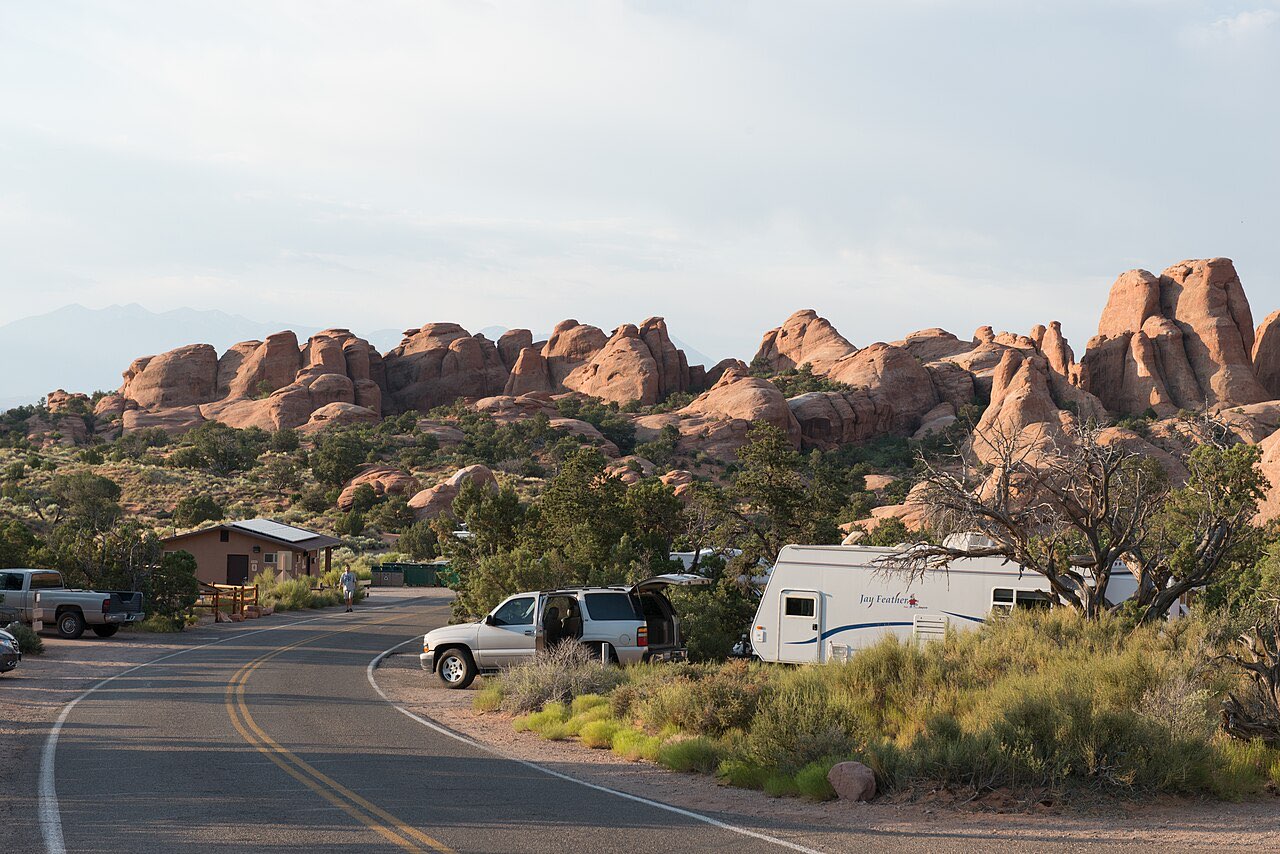
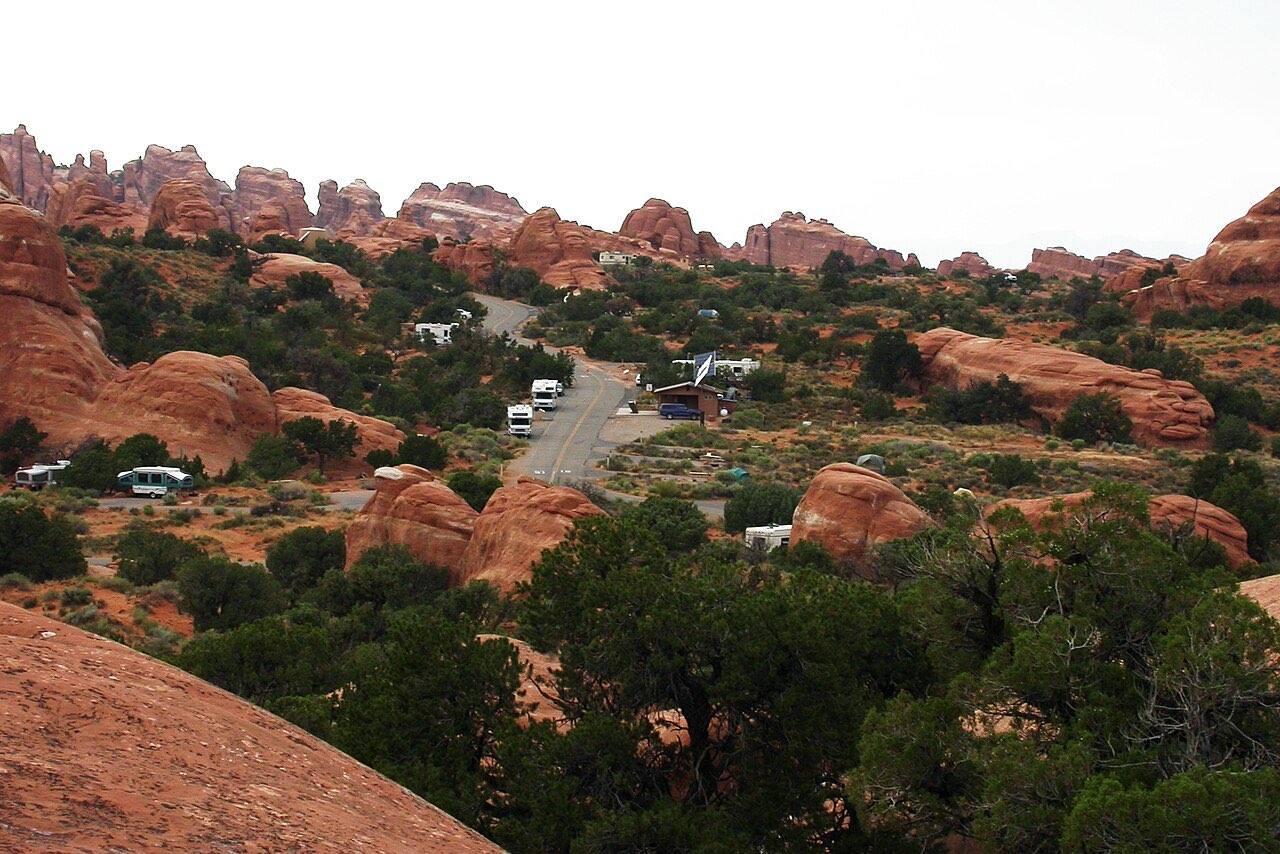
Devils Garden is at the far end of the park road, 18 miles from the entrance and 23 miles from Moab, at about 5,200 feet among the sandstone fins that give the trail its name. Roads and parking spurs are paved, there are flush toilets and drinking water, a campground host, picnic tables and fire rings, and an amphitheater with ranger programs in season. What there is not, in the park’s words: “The park does not have dump stations, or electric, water, or sewer hook-ups for RVs. There are also no showers.” Firewood is sold by coupon at the visitor center, not at the campground.
The site mix, from the maximum vehicle length Recreation.gov lists for each of the 51 sites:
| Max vehicle length | Number of sites |
|---|---|
| 40 ft | 14 |
| 38 ft | 2 |
| 36 ft | 5 |
| 35 ft | 1 |
| 30 ft | 8 |
| 25 ft | 6 |
| 20–24 ft | 4 |
| 15 ft | 9 |
| Group (tent) | 2 |
Almost every site is a back-in; only two are flagged as pull-throughs. Two vehicles are allowed per site, check-in is noon and check-out 10 a.m., and no camper may stay more than seven days per month or 14 per year. Generators run 8 to 10 a.m. and 4 to 8 p.m. The rate is $25 a night in every season, with the standard Senior and Access discounts.
Booking has two modes. From March 1 through October 31 every site is reservation-only and, per the park, “usually full every night.” From November 1 through February 28 it is first-come, first-served, paid by Scan & Pay in the Recreation.gov app or a self-registration envelope; the park tells winter campers to install the app before arriving because cell service is thin. The facility page does not state the booking lead time; Recreation.gov’s standard six-month window applies unless the park says otherwise, and our Recreation.gov guide for RVers covers how to watch for cancellations. Source: Devils Garden on Recreation.gov and the park’s camping page.
Getting in: no timed entry in 2026, but the lots still fill
For four seasons Arches ran a timed-entry pilot that required a reservation to enter between early morning and late afternoon in spring and fall. On February 18, 2026 the park announced it “will not require advanced timed-entry reservations this year” and that visitors “may enter the park at any time during operating hours.” The release left the door open for future years and warned that busy weekends and holidays may bring entrance lines and limited parking.
What you still need is the entrance fee: $30 per private vehicle for seven days, $25 per motorcycle, $15 per person on foot or bike, or the $55 Southeast Utah annual pass that also covers Canyonlands, Natural Bridges and Hovenweep, as of October 2026. The park is open 24 hours, is busiest March through October, and recommends arriving before 8 a.m. or after 3 p.m. The entrance is five miles north of Moab on US-191 and the road climbs steeply through switchbacks from the gate; it is a paved park road with no posted RV restriction, but the viewpoint lots at Delicate Arch, the Windows and Devils Garden are tight for anything long, and a campground reservation does not create a parking space. A campsite at Devils Garden is the one reliable way to have a rig inside the park on a spring Saturday; drive the tow vehicle to the trailheads.
Canyonlands Island in the Sky: Willow Flat
Island in the Sky, the Canyonlands district nearest Moab, is about 10 miles north on US-191 then west on UT-313, roughly 40 minutes to the visitor center. Its campground, Willow Flat, has 12 first-come, first-served sites, open year-round, with toilets, tables and fire rings and no water; the visitor center has water year-round. Third-party reproductions of park data list the fee at $15 a night and a practical length of about 28 feet, but the park’s own campground page would not load for us in October 2026, so treat both as “check the Recreation.gov POI page or the entrance station.” The district has no dump station. If you want more on the Needles and the longer Canyonlands and Capitol Reef loop, our Canyonlands and Capitol Reef RV camping guide covers the Needles campground and the Fruita orchard sites.
The BLM campgrounds: $20, first-come, no water
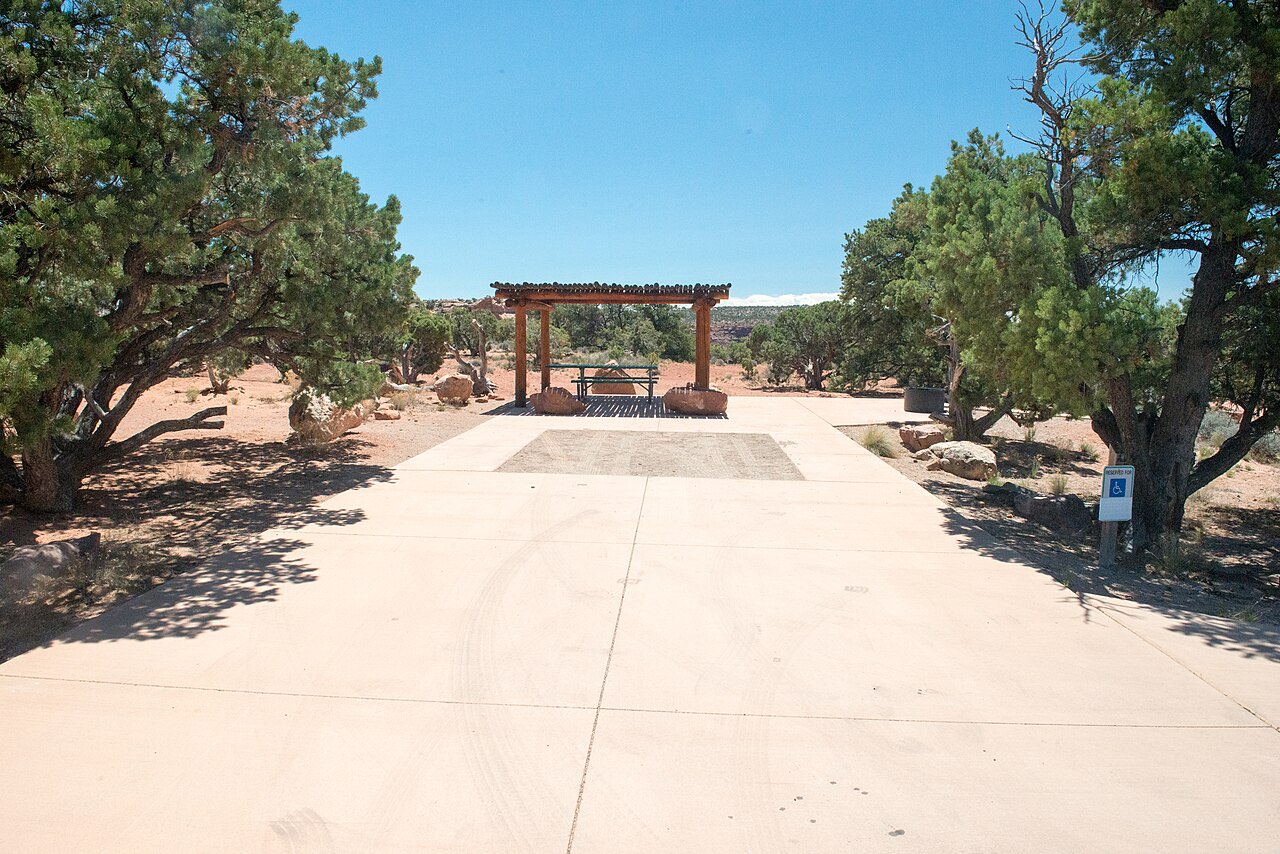
The Bureau of Land Management’s Moab Field Office runs a string of developed campgrounds on three corridors out of town. The rules are nearly identical everywhere: $20 per site per night, paid in exact cash or check at the self-service station, no water, vault toilets, no hookups, 14 nights in any 30 days, and almost all of it first-come, first-served. The BLM pages note that these sites “typically fill in the morning from March to October.”
| Campground | Corridor | Sites | Reservations | Notes |
|---|---|---|---|---|
| Goose Island | UT-128, 1.4 mi east of US-191 | 20 + 2 group | First-come (group sites on Recreation.gov) | On the Colorado River; closest to town and to Arches |
| Horsethief | UT-313, 12 mi west of US-191 | 83 + 5 group | First-come | 56 RV-capable sites in Appaloosa, Buckskin and Cayuse loops; Dapple loop tent-only, no generators; closest to Island in the Sky and Dead Horse Point |
| Ken’s Lake | 8–10 mi south of Moab | 48 + group | Loop A reservable on Recreation.gov (same day to 6 months); Loop B first-come | Loop A built for big rigs: 16 sites rated 60 ft; Loop B 27–35 ft and hard to turn around in; Loop A closes in low season |
Sources: the BLM pages for Goose Island, Horsethief and Ken’s Lake, and the Ken’s Lake Recreation.gov listing. Goose Island is the first of several riverside campgrounds strung along Highway 128 (Grandstaff, Drinks Canyon, Big Bend and others follow); the BLM pages do not publish length limits for most of them, and the river sites are generally tight for anything over about 30 feet, so scout in the tow vehicle before committing a long trailer down a one-lane loop. Generators at Ken’s Lake are allowed 8 a.m. to 8 p.m.; quiet hours are 10 p.m. to 6 a.m.
Dispersed camping on BLM land around Moab is heavily restricted to designated sites and areas; the Sand Flats Recreation Area above town is fee camping, and much of the rest is closed. If you are counting on it, read the current BLM Moab camping rules first and see our sister site’s boondocking for beginners for how to carry enough water for a week of desert dry camping.
Dead Horse Point State Park: the only public hookups
Dead Horse Point sits at the end of UT-313, a few miles short of Island in the Sky, and it is where the electric is. Per Utah State Parks:
- Kayenta Campground: 21 sites, all with 20/30/50-amp electric hookups.
- Wingate Campground: 31 sites, 20 with electric (RV or tent) and 11 hike-in tent sites; RV sites rated up to 56 feet; a dump station at the campground entrance.
Both campgrounds carry the same warning: “Water is not available to fill up RVs.” The park trucks water in, bathrooms have running water, and the nearest fill is Moab, 30-plus miles back. All sites require a reservation through Reserve America (1-800-322-3770); unreserved sites can sometimes be bought first-come on the day of arrival at the park. We saw a $50-per-night RV rate plus $20 per extra vehicle for Wingate quoted from the park’s rate page in a search result but could not read it on the page itself, so treat the price as “around $50” until you see the booking screen. Sources: Kayenta and Wingate. If your rig is 50-amp and the pedestal offers 30, our sister site’s 30-amp vs 50-amp guide covers what you can run.
Dumping, filling and the Moab logistics
Because nothing on federal land here has a dump station or RV water fill, Moab is the service stop at both ends of the trip. Grand County’s tourism office keeps a list of RV dump and fill stations that, when we read it, included a farm-supply store on South Main at $5, a fuel station on South Highway 191 with a free dump, and several private RV parks charging $5 to $15 for non-guests; the county disclaims the list and prices change, so call ahead. Dead Horse Point’s Wingate dump is the only one on the UT-313 side. For a refresher on the hose order, see how to use an RV dump station.
Fill fresh water in town, carry extra jugs for a BLM stay (the sites have none), and remember that Devils Garden’s water is drinking-water spigots, not a fill hose. Moab also has the propane, groceries and laundromats you will not find at any of the campgrounds above.
A decision guide by rig
- Under 25 feet, any season: Devils Garden if you can get it; otherwise Goose Island or another Highway 128 site, arriving mid-morning; Willow Flat for Canyonlands.
- 25 to 40 feet, March to October: book a 36- to 40-foot Devils Garden site the day the window opens; back it up with Ken’s Lake Loop A, which is reservable and sized for you, or Horsethief’s RV loops if you arrive early.
- Over 40 feet, or anyone who needs power: Dead Horse Point (Wingate for length, Kayenta for guaranteed electric), then Moab’s private parks. Nothing in Arches or Canyonlands is built for you.
- November to February: Devils Garden is first-come and often has space; nights are below freezing at 5,200 feet, so plan for tank heaters or winterized lines. Our death valley guide covers the same cold-desert winter tradeoffs.
Mistakes to avoid
- Booking a 25-foot Devils Garden site for a truck and 22-foot trailer. The length is total parked length; if the truck cannot sit alongside, it counts.
- Arriving at Goose Island at 4 p.m. in April. The BLM says the sites fill in the morning from March to October, and there is no reservation to fall back on.
- Bringing only a card to the BLM sites. Exact cash or check at the iron ranger; Ken’s Lake Loop A is the exception.
- Expecting to fill water at Dead Horse Point. You cannot; fill in Moab.
- Assuming timed entry still applies, or assuming it never will again. 2026 had none; 2027 was undecided when we checked.
- Driving a 38-foot motorhome to Delicate Arch at 10 a.m. The lots fill with cars; park the rig at camp and take the tow vehicle.
Heading on to the rest of southern Utah? Bryce Canyon RV camping has the same per-loop breakdown and the Red Canyon tunnel question, Zion RV length limits covers the Mt. Carmel tunnel rules that changed in June 2026, and national park RV size limits collects every park’s numbers in one table.
Frequently asked questions
What is the RV length limit at Devils Garden Campground in Arches?
There is no single limit; each of the 51 sites has its own maximum vehicle length on Recreation.gov. As of October 2026, 14 sites are rated 40 feet, two at 38, five at 36, one at 35, eight at 30, six at 25 and the rest 15 to 24 feet. Book by the site's figure and remember it covers the total parked length, so a truck and trailer count together unless the truck fits beside the trailer.
Does Arches require timed entry reservations in 2026?
No. On February 18, 2026 the park announced it would not require advance timed-entry reservations this year, and visitors may enter at any time during operating hours with a normal entrance pass. The park warned of entrance lines and full lots on busy weekends and recommends arriving before 8 a.m. or after 3 p.m. Whether timed entry returns in 2027 had not been announced as of October 2026.
Is there a dump station at Arches National Park?
No. Devils Garden has flush toilets and drinking water but, in the park's words, 'The park does not have dump stations, or electric, water, or sewer hook-ups for RVs.' The BLM campgrounds around Moab have none either. Dump in Moab before and after; Grand County publishes a list of stations with fees in the $5 to $15 range, and Dead Horse Point State Park has one at Wingate Campground.
How much does camping cost at Devils Garden and the Moab BLM campgrounds?
Devils Garden is $25 a night year-round, reservation-only from March 1 to October 31 and first-come with Scan & Pay from November through February. The BLM campgrounds along Highway 128, Highway 313 and at Ken's Lake are $20 a night; most are first-come, cash or check at the site, except Ken's Lake Loop A, which is reservable on Recreation.gov. Arches entry is a separate $30 per vehicle for seven days.
Where can a big rig with hookups stay near Arches?
Inside any park, nowhere. The closest public hookups are at Dead Horse Point State Park, where Kayenta's 21 sites all have 20/30/50-amp electric and Wingate has 20 electric sites rated up to 56 feet, with no RV water fill and a dump station at Wingate. Otherwise Moab's private RV parks are the option; Ken's Lake Loop A, with 16 sites rated 60 feet, is the biggest dry-camping alternative on public land.
Can you camp at Canyonlands Island in the Sky in an RV?
Willow Flat has 12 first-come, first-served sites, open year-round, with toilets but no water; the visitor center has water year-round. Third-party copies of park data list a $15 fee and sites to about 28 feet, which we could not confirm on an NPS page in October 2026. It is about 40 minutes from Moab and fills early in spring and fall.
Keep planning
- Acadia RV Camping Including Schoodic Woods
Acadia RV camping: Blackwoods and Seawall's 35-foot sites, Schoodic Woods' electric loop for rigs to 70 feet, Park Loop Road bridge heights and the Cadillac rule.
Updated Oct 2026 - Bryce Canyon RV Camping and Size Limits
Bryce Canyon RV camping: which North and Sunset loops take RVs, per-site lengths, the free dump station, the 23-foot parking rule, Ruby's Inn hookups and Red Canyon.
Updated Oct 2026 - Grand Canyon South Rim RV Camping and Trailer Village
Grand Canyon South Rim RV camping: Mather's 30-foot limit, Trailer Village hookups and rates, Desert View's size rules, the dump station and RV parking.
Updated Oct 2026